
Multicloud-Infrastructure
Sovereignty, Security and Independence made in Germany
Why go Multicloud?
Moving can always become necessary
Imagine that tomorrow your cloud provider significantly increases prices and discontinues support for a critical service. Or you are forced to switch in order to ensure that all your data is processed exclusively by European partners. For you, this means additional effort, operational disruptions, staff training for new interfaces and usually a great deal of frustration.
Common reasons for switching cloud strategy
Unexpected price increases
Changing license agreements
Data being relocated to non-EU countries
Benefits of multicloud infrastructure
Cost control
You decide who has the best offer, without being locked in by costly migration obstacles. And if the price changes, switching is quick and easy.
Data sovereignty
You decide where your data is processed, an essential requirement for many regulatory environments.
Infrastructure Control
You decide who runs your applications on what hardware and software, giving you the flexibility to choose the best fit for your needs.
Resilience
Critical systems can be maintained as hybrids in different environments to ensure operations even in the event of a full failure of a service provider.
Future-Proofing
By avoiding Vendor Lock-In your applications can always make use of the best innovations as soon as they are available.
Scalability
Scale your infrastructure according to your needs. Accessing additional ressources on short notice or scaling back to avoid cost overruns.
Strategy for digital sovereignty
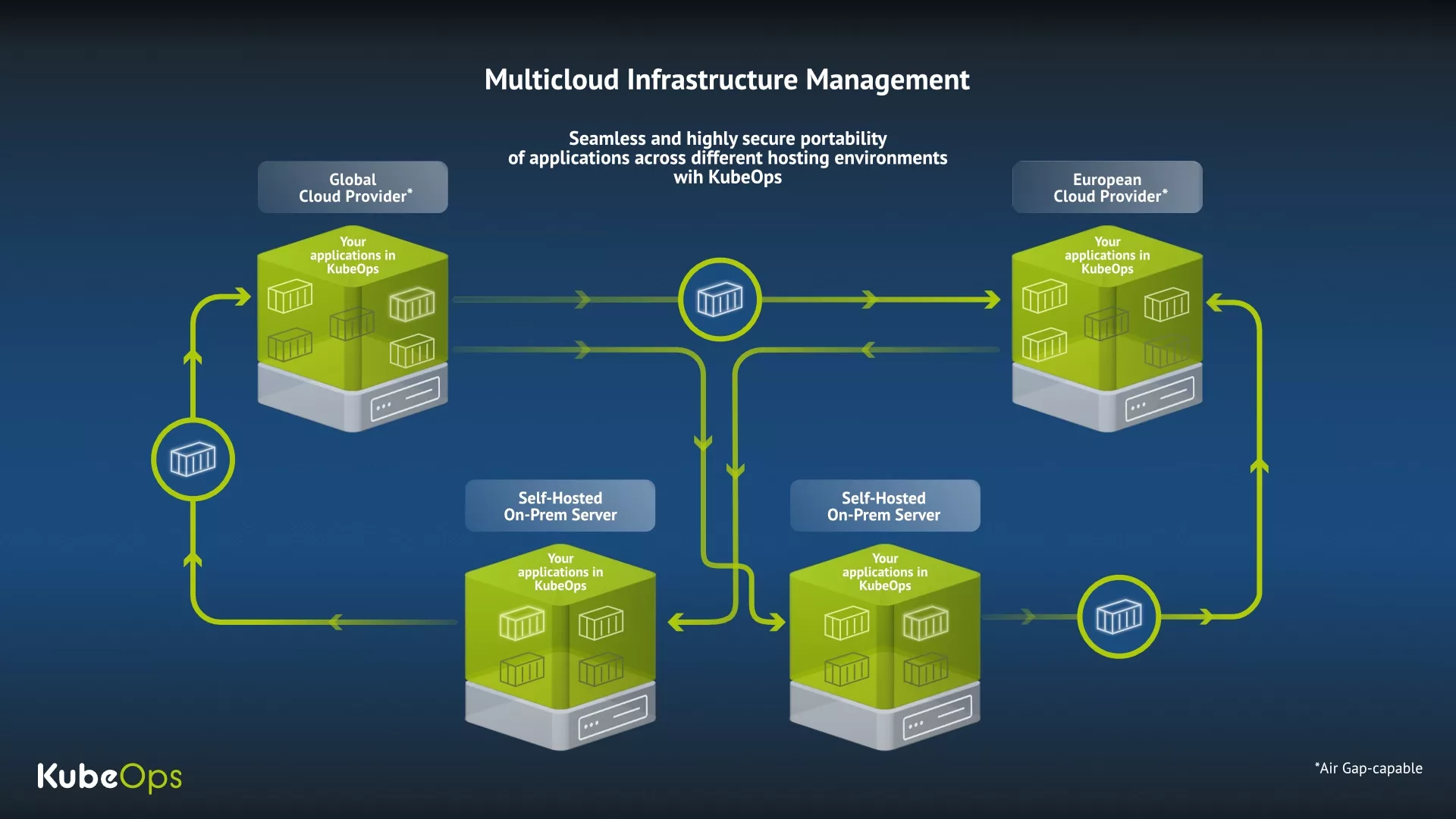
Multicloud-capable digital infrastructures are designed to operate seamlessly across different cloud environments. Whether you use a major U.S. cloud provider, run your applications in a European data center, or operate your own on-premises hardware, multicloud means you can switch quickly and easily.

Stop depending on one vendor
Thanks to the flexibility of multicloud-capable infrastructures, you are less dependent on individual providers. This increases the predictability and stability of your digital infrastructure, as you can respond more effectively to regulatory changes, price increases, and changes in licensing terms.
Learn more about our products
With KubeOps COMPLIANCE, we offer a solution for demanding applications in critical infrastructure sectors (KRITIS), independent of individual providers or infrastructures. In combination with our KubeOps Software Installer (KOSI), your Kubernetes infrastructure becomes multicloud-capable. KubeOps VM complements our portfolio with a solution that allows you to continue operating existing virtual machines with ease, while your new applications benefit from the advantages of containerization.
Want to learn more?
In our downloads section, you will find important information on building successful and sovereign cloud infrastructures made in Germany. We have compiled only a small selection here. So, take your time to explore our downloads. And if you have any questions or are ready to start making your infrastructure more sovereign, secure, and flexible, feel free to contact us!
Certified Expertise
KubeOps is not only your reliable partner for multicloud and Kubernetes, we are also leading experts in compliance. Our tools meet the highest standards of security and data protection, and we support you in complying with legal and regulatory requirements, for example through preconfigured rule sets for common compliance needs.
Frequently Asked Questions (FAQ)
1. What does “sovereign multicloud infrastructure” mean, and why is it important?
A sovereign multicloud infrastructure ensures that data processing and storage comply with German and European data protection laws—distributed across different providers and solutions. It protects against unauthorized access from foreign legal jurisdictions and gives public authorities and KRITIS organizations maximum control over their data. For industries with high compliance requirements—such as automotive, healthcare, or public administration—this level of data sovereignty is essential.
2. What are the benefits of containerization?
Containerization enables applications to run in isolated, portable environments. This increases flexibility and scalability, as individual workloads operate independently of the underlying infrastructure. In a sovereign cloud, organizations also benefit from legally compliant hosting and optimized resource utilization—ideal for modern DevOps and CI/CD processes.
3. How does Kubernetes support the operation of sovereign cloud solutions?
Kubernetes is the leading platform for container orchestration, automating the deployment, scaling, and management of applications. In sovereign cloud environments, Kubernetes ensures high availability, dynamic load balancing, and efficient resource utilization. Public administrations, KRITIS organizations, and other enterprises with heightened data security needs can securely and efficiently operate complex multicloud or hybrid scenarios as a result.
4. What security mechanisms are integrated into sovereign cloud environments?
Sovereign clouds rely on zero-trust architectures, end-to-end encryption, and strict access controls. Container images are regularly scanned, and Kubernetes provides built-in security features such as Role-Based Access Control (RBAC). In addition, data remains in certified German data centers, protected by both physical and digital security measures.
5. How can the lifecycle of a sovereign cloud infrastructure be managed efficiently?
Effective lifecycle management includes planning, implementation, operation, and continuous optimization. Containerization and Kubernetes simplify updates and scaling, while KubeOps' and our parent company Bechtle’s managed services ensure monitoring, patch management, and compliance. This keeps the infrastructure up to date, secure, and high-performing at all times.
Interested?
Get to know us and our products in a free initial consultation. We focus on identifying bottlenecks and creating proposals for individual solutions for your Kubernetes needs and goals.