

Why go Multicloud?

Moving can always become necessary
Imagine that tomorrow your cloud provider significantly increases prices and discontinues support for a critical service. Or you are forced to switch in order to ensure that all your data is processed exclusively by European partners. For you, this means additional effort, operational disruptions, staff training for new interfaces and usually a great deal of frustration.
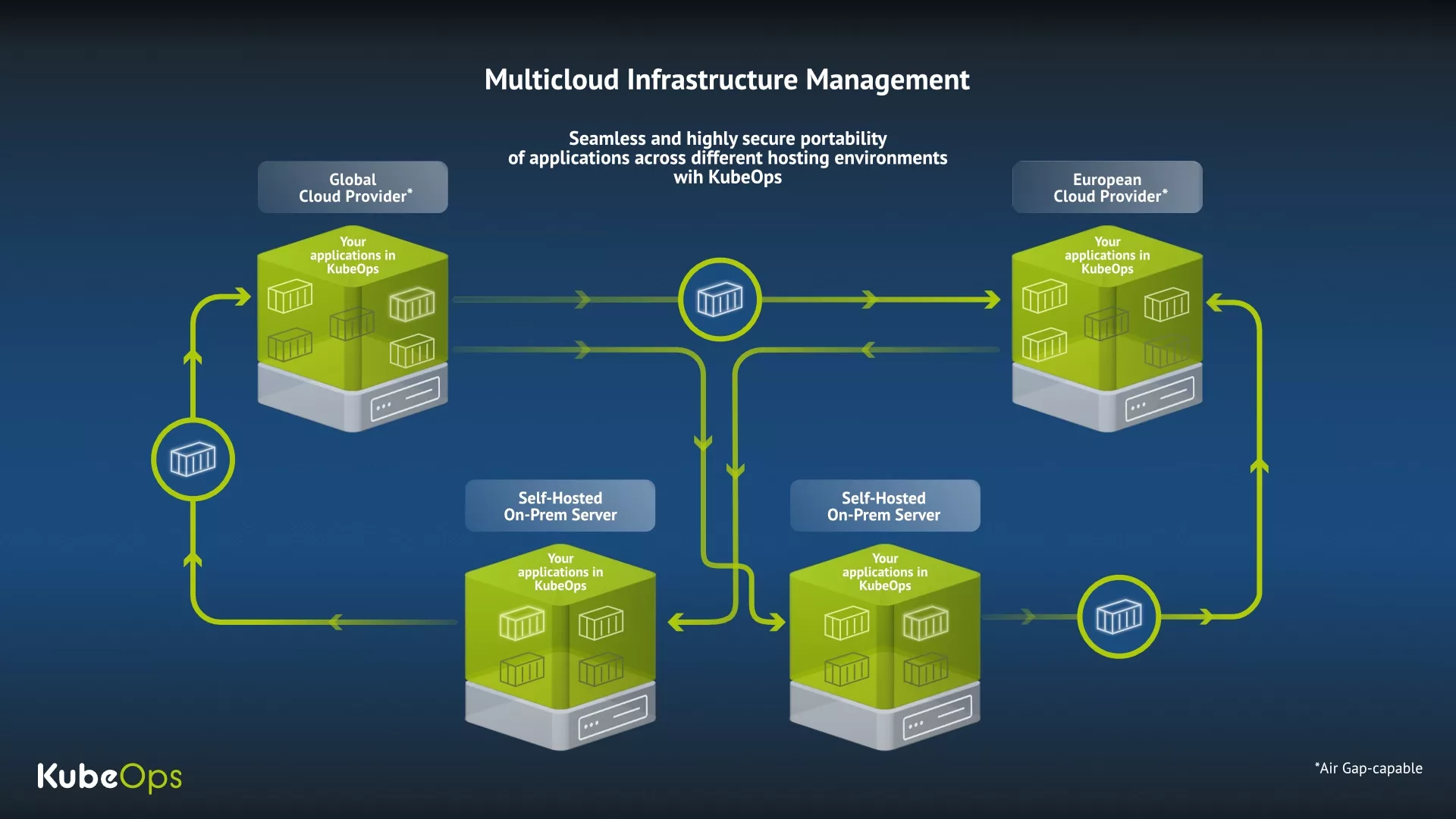
Benefits of multicloud infrastructure
Cost control
You decide who has the best offer, without being locked in by costly migration obstacles. And if the price changes, switching is quick and easy.
Data sovereignty
You decide where your data is processed, an essential requirement for many regulatory environments.
Infrastructure Control
You decide who runs your applications on what hardware and software, giving you the flexibility to choose the best fit for your needs.
Resilience
Critical systems can be maintained as hybrids in different environments to ensure operations even in the event of a full failure of a service provider.
Future-Proofing
By avoiding Vendor Lock-In your applications can always make use of the best innovations as soon as they are available.
Scalability
Scale your infrastructure according to your needs. Accessing additional ressources on short notice or scaling back to avoid cost overruns.
Strategy for digital sovereignty
Multicloud-capable digital infrastructures are designed to operate seamlessly across different cloud environments. Whether you use a major U.S. cloud provider, run your applications in a European data center, or operate your own on-premises hardware, multicloud means you can switch quickly and easily.


Stop depending on one vendor
Thanks to the flexibility of multicloud-capable infrastructures, you are less dependent on individual providers. This increases the predictability and stability of your digital infrastructure, as you can respond more effectively to regulatory changes, price increases, and changes in licensing terms.
Learn more about our products
With KubeOps COMPLIANCE, we offer a solution for demanding applications in critical infrastructure sectors (KRITIS), independent of individual providers or infrastructures. In combination with our KubeOps Software Installer (KOSI), your Kubernetes infrastructure becomes multicloud-capable. KubeOps VM complements our portfolio with a solution that allows you to continue operating existing virtual machines with ease, while your new applications benefit from the advantages of containerization.





Interested?
Get to know us and our products in a free initial consultation. We focus on identifying bottlenecks and creating proposals for individual solutions for your Kubernetes needs and goals.
